
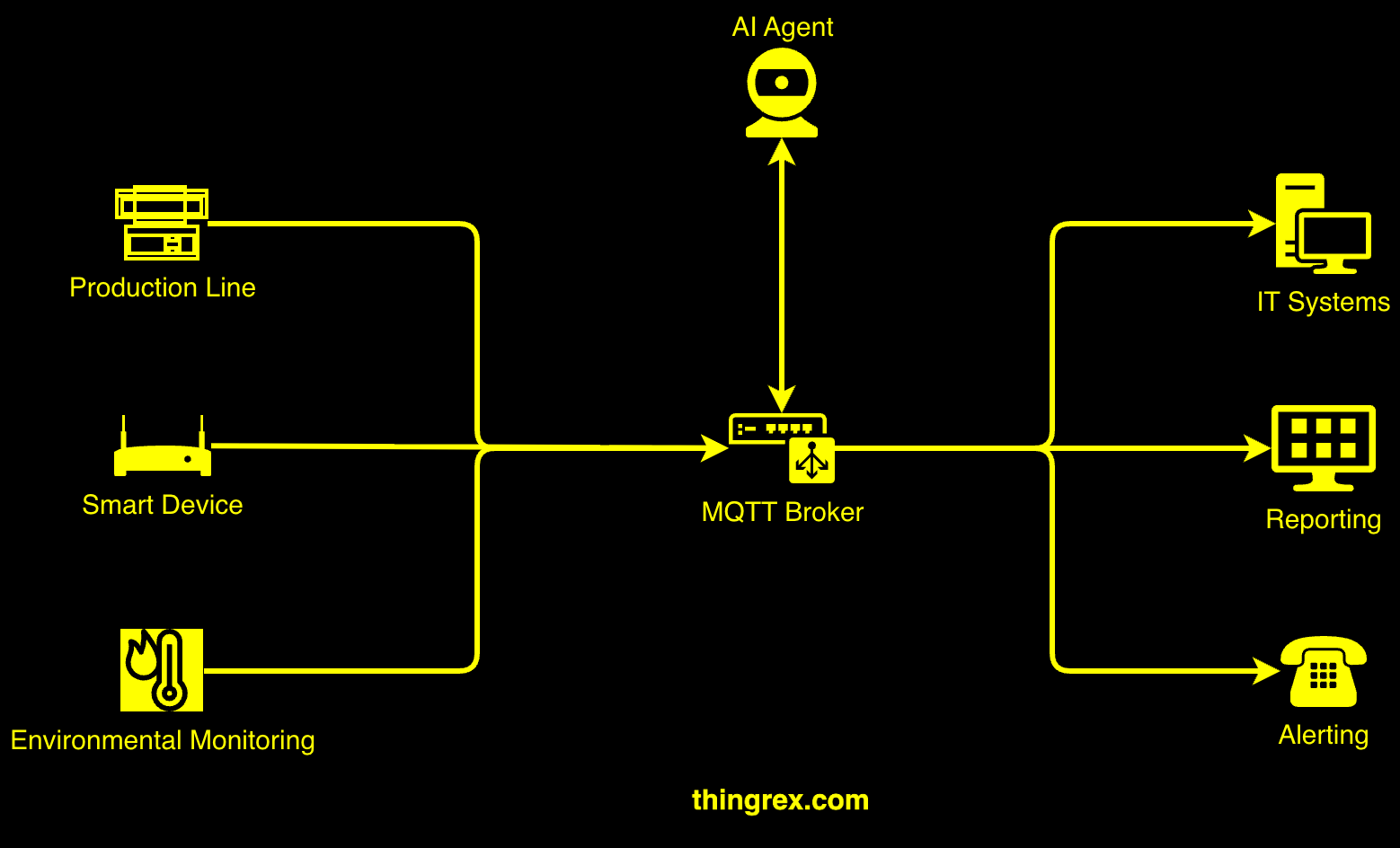
I have been experimenting with various AI agentic workflows over the past months, testing different architectural patterns and seeing where they deliver real value. Suddenly, I realized this technology is a perfect fit for IoT workloads that use MQTT (the primary protocol for managing devices).
I have worked with MQTT for years, but I had not connected it to AI agents until recently. MQTT’s pub/sub architecture creates something unique: a continuous data stream that agents can subscribe to without impacting the environment. Every sensor reading, every device status, error codes flow through a dedicated topic. You do not need new APIs or changes to device firmware. Your AI Agent can simply subscribe*.
This matters because the struggle I keep seeing in IoT deployments is not connectivity or data collection.
- Companies have dashboards.
- They have alerts.
- They have terabytes of archived sensor data.
What they lack is intelligent context. Someone has to look at the screen and use their domain knowledge to decide whether a temperature spike matters.
An agent subscribing to MQTT appears to be an obvious solution. It receives messages in real-time, maintains a device-fleet perspective, correlates patterns that no human could track manually, and provides recommendations backed by explained reasoning (you do not want to install a black box in your facility). It acts as the anomaly detection understands context - this temperature spike is normal during production cycle A, uncommon during cycle B, and dangerous when production is idle.
The best part is that agents do not require infrastructure changes. Your dashboards still work. Your alerts still arrive. And in parallel, you test and fine-tune your new solution.
If you use MQTT in your system, the transport layer is already in place. The reasoning layer is what we are now adding.
👉 Would you be interested in exploring this topic further?
*) During the experimentation phase, your agents should have read-only permissions (enforced by the MQTT Broker). That approach enables connecting agents to production environments with zero impact**.
**) I recommend using test environments for experimentation, but there is a way to make production testing safe by utilizing your existing infrastructure.