
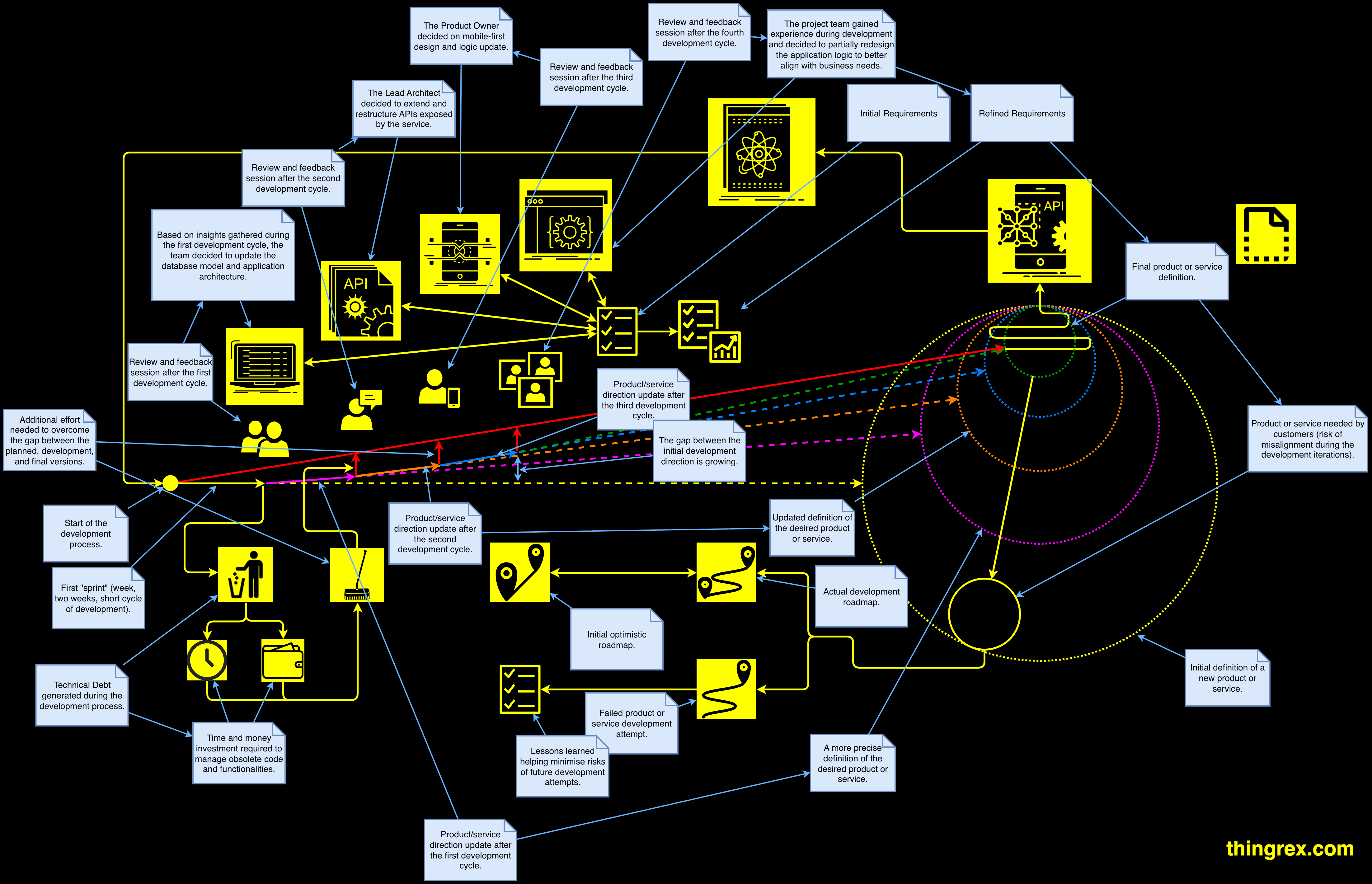
This diagram illustrates a pattern I see in hardware-enabled SaaS initiatives. You start with initial requirements and an (optimistic) roadmap.
Then reality shows up:
❌ The field data disagrees.
❌ Ops workflows change.
❌ Customers/stakeholders ask for “just one more adjustment."
❌ The team constantly refactors APIs, reshapes the data model, rewrites logic, etc.
Each iteration does improve the product…
…but it also creates iterative debt: leftover code paths, half-migrated schemas, compatibility layers, rushed fixes, duplicated logic.
The bottom line: the project direction moves faster than your business can verify it. So the “gap” grows:
- gap between planned vs actual roadmap
- gap between what you built vs what customers need
- gap between engineering reality vs business strategy
And you start paying for it twice:
- You pay to build the next version
- You pay again to adjust the old versions to the new requirements
In generic SaaS, this is annoying. In the industrial world, this results in:
- downtime in operations
- failed device updates
- exploding cloud bills
- vendors “shipping features” while you absorb the risk
The Solution:
What I do as a Fractional CTO in these situations is not “more agile.” I introduce governance for iterations:
✅ Decision checkpoints: after each cycle, what changed in requirements, and why?
✅ Architecture runway: what must be stabilized before the next sprint?
✅ Vendor accountability: who owns the cost of rework?
✅ Operational fit: will it work when connectivity is bad and humans are stressed?
Remember: iteration should reduce uncertainty. If it increases entropy, your process is broken.
👉 Use Q to email me “CHECK” and I’ll send you the 10-Question Reality Check I use to audit sprints.