
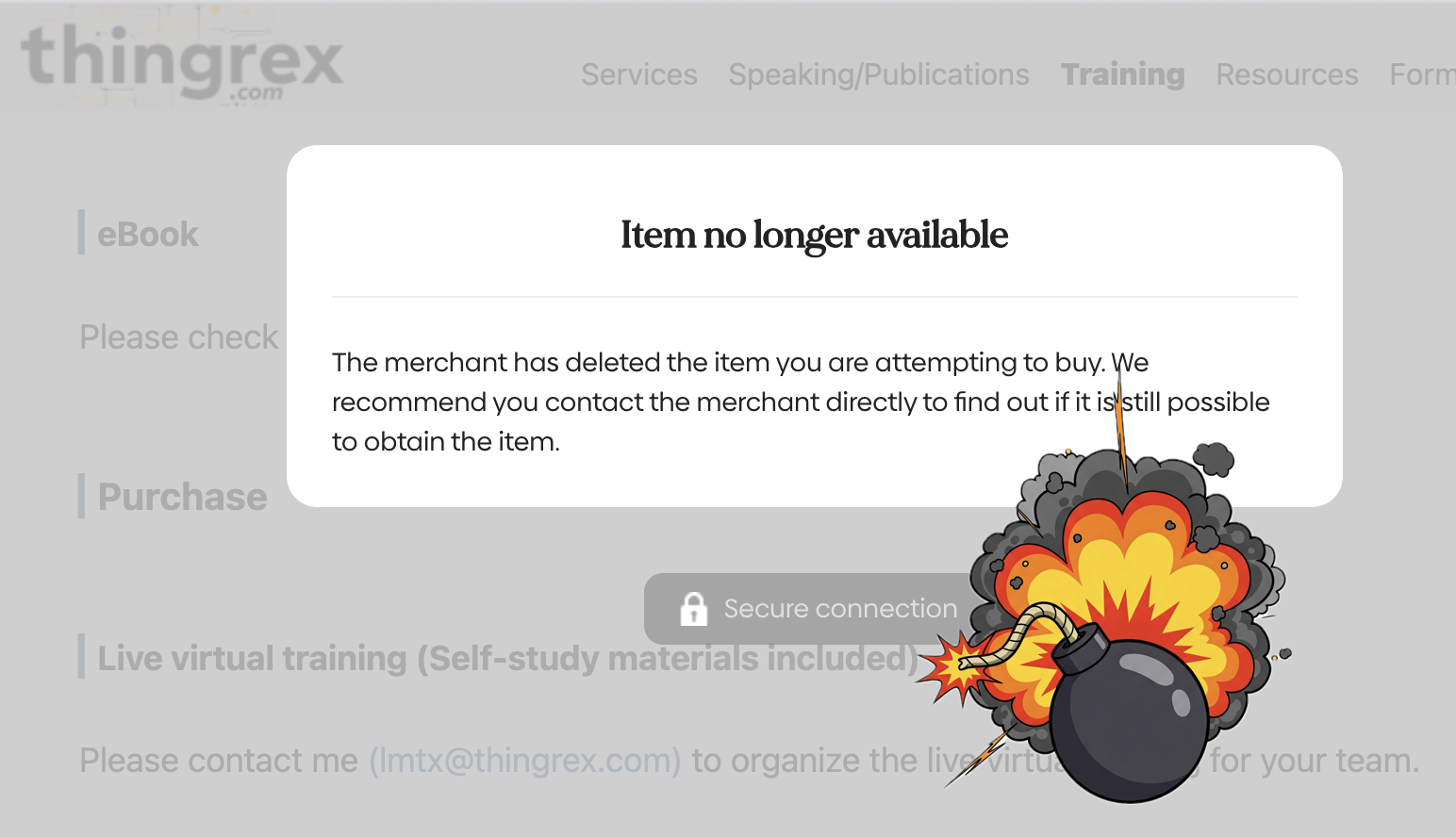
People say that every challenge we encounter is an opportunity in disguise. That is probably true, but that does not mean it is a good spot to be in.
When I decided to offer advisory services on my website, I wanted to implement the payment system in the “standard way.” I resisted the temptation to implement everything myself and researched platforms offering product catalogs and payment integration. I found a solution, integrated it with Stripe and my website, and happily used it for over a year… until this morning.
I received an email informing me that my account had been migrated, which resulted in a new pricing. Up until now, I have been paying a percentage of every transaction - a fair approach. According to the new terms, I should pay a fixed fee higher than 100 USD every month and a percentage of every transaction.
I refused to accept that and immediately terminated my account. I will continue this story in my future posts. For now, I need you to focus on the most important factor.
There are significant risks attached to the convenience offered by external providers. For example:
↘️ We do not have control over the available functionalities - the vendor can introduce changes at any time, which may or may not play nicely with our overall setup.
↘️ We do not have control over the expenses - the vendor can change pricing at any time and ask us to resign if we are not happy with the new terms (which I did).
↘️ We do not have control over the impact on the user experience - all of the above might result in a significant impact on the user experience; we do not control our end-to-end solution, so we do not control the end-user experience (something Apple excels in over the years).
This is yet another angle to consider during the buy vs. build discussions.
👉 Have you ever encountered this kind of situation? How have you handled that? What is your solution to stay secure in the future?